How to build group programs students love and your school can actually sustain
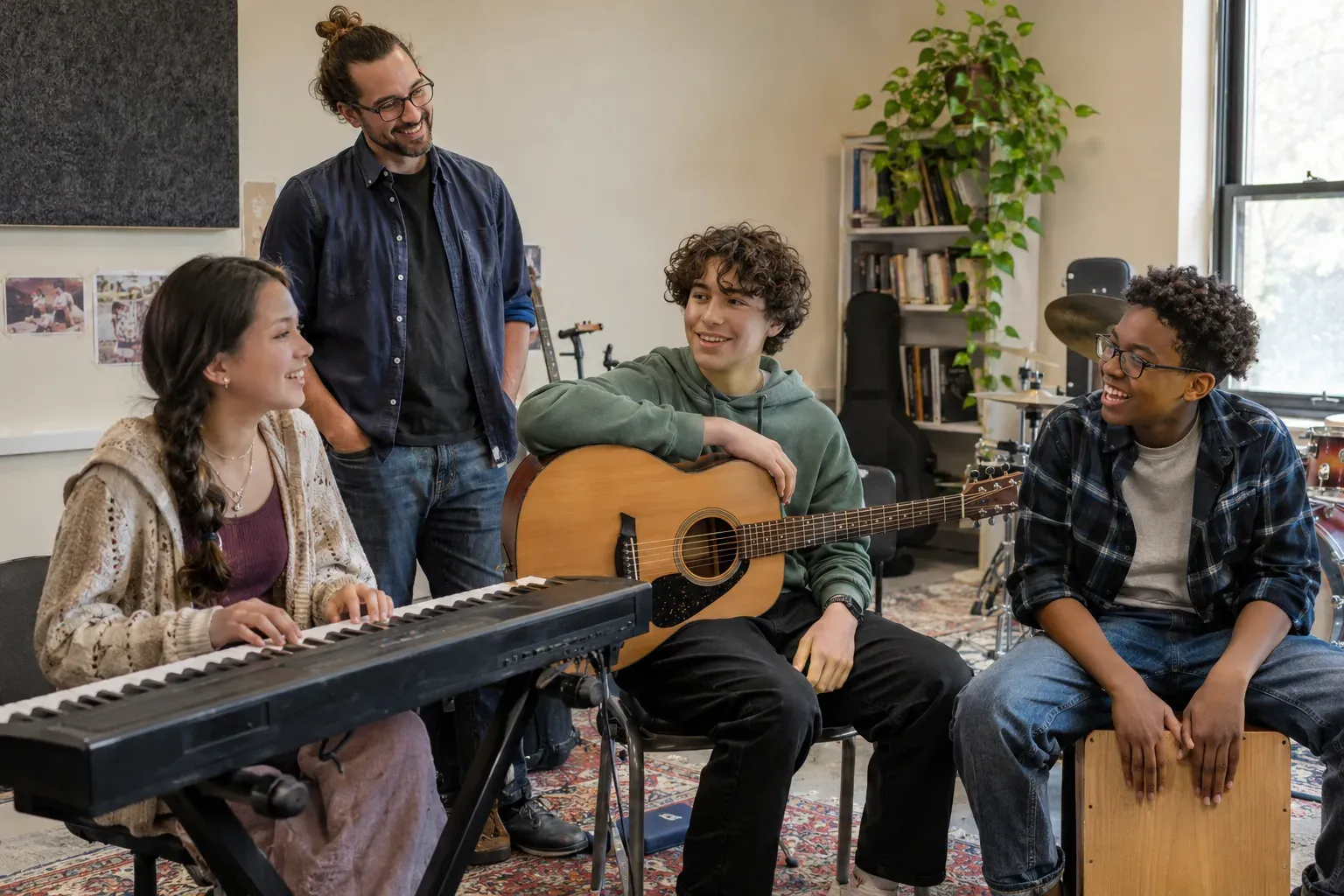
One thing I've learned running a music school is that parents can love the idea of their kid joining a band, right up until you ask them to bring that kid in for another hour every Tuesday.
I get it. Between school, sports, homework, and everything else families are juggling, another weekly commitment can be a tough sell.
At So i Heard, I've always wanted the school to be more than a bunch of private lesson rooms. Playing with other people is a huge part of learning music. You can practice a song on your own for months, but something changes when you have to listen to a drummer, follow a bass player, and get through the whole thing with other musicians.
The question is how to offer more of those experiences without creating a schedule full of half-empty classes that are expensive to run.
Figure out what the program is supposed to accomplish
I'd start by separating the different types of group experiences, because they don't all need to work the same way.
If you're putting together a band that will rehearse for a show, you need a consistent lineup. The students should be reasonably close in age and ability, the instruments need to make sense together, and everyone has to be able to commit to rehearsal.
An open jam is a completely different setup. Students can come in, play with whoever's there, and get some experience making music with other people. A songwriting workshop or masterclass might only need to run once, with a specific topic and instructor.
Each format has its place. I'd define what the student gets out of it, what they're committing to, and what the school needs to provide before putting anything on the calendar. If I can't explain those things to a parent in a couple of sentences, the program probably needs more work.
Run the numbers before you announce a class
Group programs can look pretty attractive financially. For a simple illustration, say six students each pay $150 a month for a weekly band class. That's $900 in monthly revenue.
If four rehearsals cost $50 each in fully loaded instructor time, you're spending $200 on instruction. That leaves $700 before room costs, preparation, administration, credit card fees, and overhead.
Now say only two students enroll. You're bringing in $300, but you're still spending that $200 on the teacher. Suddenly you've got $100 left to cover everything else. Add a second instructor, and the math gets worse.
This is why I'd set minimum and maximum enrollment before promoting the class. I'd also decide how long we're willing to try filling it, what happens if it doesn't reach the minimum, and how cancellations or missed rehearsals work. The teacher should know what they're being paid and what's expected of them. Parents should know what they're signing up for.
Find the right students before you start recruiting strangers
One of the biggest advantages a music school has is that its teachers already know the students. They know who is ready to play in a group, who loves classic rock, who's been asking about performing, and who might be losing interest in private lessons because they need something new to work toward.
The annoying part is getting all of that information out of individual lesson rooms and into an actual group.
Maybe you have two guitar students at a similar level, a drummer who's ready to play with others, and a bassist who would be a great fit. Those students might already be on your schedule. Somebody still has to find them, check availability, confirm the fit with their teachers, contact the parents, and follow up.
This is one of the problems Sam and I want to solve with Music School Manager. Band matching is a future idea: a tool that could compare students by age, instrument, progress level, and availability, then suggest possible groups for an admin to review. Today, staff need to identify those groups themselves. Pipelines can help organize the enrollment follow-up once the team has decided whom to invite.
I wouldn't let software decide whether two kids will work well together musically or socially. That's still a conversation with the teachers. But the admin work involved in finding and organizing those students shouldn't be the reason a good band never gets started.
Give families a way to participate without another weekly commitment
We recently asked families at So i Heard what they'd like to see more of. One of the clearest themes was interest in group activities without having to sign up for another recurring class.
That feedback makes sense, and it's influencing what we're offering. We're introducing open jams, teacher office hours, masterclasses, and other ways for students to get more involved at the school.
I like the flexibility of this approach. A student can try playing with others without committing to an entire season. Teachers get a chance to see who clicks together. If a few students keep showing up and want more, there's a good reason to explore a regular band or ensemble.
It also gives us a chance to see which programs families actually use before assigning a teacher and a room to another permanent weekly time slot.
Make it worthwhile for the teachers
I think this part gets overlooked. Some teachers love coaching bands. Others are great at songwriting, production, improvisation, or working with beginners who need extra help. Group programs give teachers a chance to use more of those skills and earn additional income.
But if the roster changes every week, the schedule keeps moving, or the teacher is expected to spend hours preparing without getting paid for it, they're not going to be excited about running the program for very long.
I'd involve the teachers early, figure out what kinds of groups they actually want to lead, and be clear about compensation and prep time. You also get better programs when the teacher has some ownership of what they're building.
Pay attention to what happens after students participate
Obviously, I want to know how many students signed up, how often they attended, and whether the revenue covers the cost of running the group.
I'd also want to know whether those students are more engaged in their private lessons. Are they practicing more because they have a show coming up? Are they making friends at the school? Are they staying enrolled longer? And are their teachers seeing progress?
Those are harder things to measure, but they're part of the reason to offer group programs in the first place. A workshop that barely breaks even might still be worth running if it makes the private lesson experience better and gives students a reason to stick around. I'd want some evidence of that before assuming it's true, though.
For now, I like starting with a few formats, seeing what families respond to, and expanding the ones that earn their place on the schedule. That's a much more manageable way to build the kind of music school I've always wanted.
What group program has been easiest to fill at your school? And which one sounded great but was harder to get off the ground?